


Joe Kine, one of the last high scalers to perform this amazing job, is a reminder that it is the heart and the soul of every individual which allows celebrations to spread across the globe. We're talking from international soccer to a day set aside to commemorate independence. For, without one, then none.
Joe Kine, how I would have liked to know you, the way you felt hanging so high in the sky against that red-black canyon wall. Did you ever fear for your life, were there moments that kept you wondering if today would be your last? Or did you just get used to what you were doing, not thinking of the danger so much as the job at hand?
Well, here's to you, Joe. And to the sculpture at the dam which celebrates your life as a high scaler. Though you were so much more than a scaler in your own "kine-ness" you represented then and now what we will always need in the future--a human being to be celebrated for performing the extraordinaire.
Saturday, July 3, 2010

Thursday, July 1, 2010
Corruption
August, 1931, the mucking crew at the site of the Hoover Dam were fired if they did not accept the wage reduction. They were only making four dollars a day in the first place. Now, the bosses were saying they didn't need the mucking work done since they had trucks to do the labor, so they'd keep everyone on the job but pay them less.
The muckers said, we deserve to be paid as we were, and, like everybody else working on the dam. Besides, muckers pay was the lowest of all already.
The bosses said, you're fired. There's too many other workers lined up ready to take the job. See ya.
The strike ensued. The workers were fired. Then hired back if they had been good workers. For a only a little less than what they had made previously. But again, yes once again, they had a job. They were forced to be happy with these conditions, for there were no other conditions.
What do we do when we feel our backs are to the wall? Kicking and screaming are reasons for ridicule. Doing nothing is a quick way to starvation. These men did what they felt they had to do at that time. It was the best they could, despite the fact it seemed the only thing they could do.
Tying the "best" to the "only" is an existence that must be temporary, for it makes a man weary, resentful, and worst of all, hopeless. Unless of course, the conditions seem to slowly get better...exactly what happened August, 1931.
Wednesday, June 30, 2010
sign of the times

High scalers at the Hoover Dam were a sign of the times. Hanging 700 feet above the ground, in tiny bosun chairs, knocking away loose rock, these men dared to demonstrate what it took to not only take a challenge but to become one. For who could top a feat such as this?
When the designers of the dam set to planning such feats did they realize they were molding men to forever be remembered for such a dangerous job? And though the pay for being a high scaler was about equal to the other dangerous job at the dam, those who walked into a tunnel to be sure the blasting had finished, it was nothing compared to a company man.
And how did one become a company man? The sign of the times offered only this: who would want to be when you could possess so much glory at a job that meant risking your life?
Tuesday, June 29, 2010
Mess Hall

Fine dining, three squares a day, as much as a man could want to eat, these were the sentiments of the workers at the dam, who ate at the Anderson Brothers' big tent or mess hall. With a cigar chewing cook and a lot of bull cooks (servers and bus boys) the meals were served three times a day to over a thousand men. Lunch of course was packed in wrappers, sandwiches and fruit. But breakfast there were eggs, meats, biscuits, gravy and lots of coffee. At dinner there were steaks and chops, potatoes and rice, vegetables of all kinds, with cream pies and cakes. The men could eat as much as they wanted, which in the beginning was quite a lot. Once they figured the effect of eating so much (hard to do when it's extremely hot working conditions) they cut back on the food but still poured on the salt by a recommendation for their health. Without enough salt in the diet, sweating all day like they were, salt was a saviour.
To sit with a group of seven other men at a table discussing the day's work was pleasurable. But what really counted for many men might have been the feeling they were getting taken cared of. They did not have to worry where the food was coming from, it just was and plenty of it. A false sense of security?
A continuation of the times they'd just left behind, but even more so, for being so desperate?
Nonetheless, camaraderie was high. Food was decent, even if it got tiring as the days turned into weeks then months without any time away from the job. The real pleasure then had been taken out of the equation. It wasn't every man for himself, oh no, it was every man for every man for every man the job must get done.
Monday, June 28, 2010
Hero's Journey part IV
Joseph Campbell's Hero's Journey is an archetypal pattern that forms the underlying structure of every story ever told, even the story of our own lives. The fourth step of the 12 steps to the journey is The Crossing of the First Threshold.
"The Crossing..." in summary, is the point where the person actually crosses into the place of adventure, leaving the known rules and laws of his/her world and venturing into the unknown and dangerous realm where the limits are not known.
In the novel, Hard Luck, the protagonist, 14 year old Jake Adams has come to the Hoover Dam out of necessity. His parents are dead, his baby brother in an orphanage, the current economic depression has forced him to travel west from his home in Oklahoma. What he finds when he arrives is a picture of tragedy balanced by hope.
As he proceeds to get a job mucking and is glad for it, at the same time he wants to be like his buddy Eddie who work as a dynamite nipper. It's not until Jake realizes Eddie isn't going to encourage him, that he begins his fight as an underdog, thus crossing the first threshold.
Now he must not only communicate his desire but prove he will strive for it by engaging in activities that will ultimately strengthen the outcome of his journey.
Sunday, June 27, 2010
The law
The law doesn't measure attitude it measures justice. In 1931, this was the reality in Boulder City. The town was owned by the U.S. Department of Reclamation. The town prospered, the people that lived there even those that do today are comfortable, there's a feeling a safety that permeates the streets lined with trees, a park in the center of town and a community that continues to thrive.
Diversity however? Not so much. Oral histories of citizens that lived here while the dam was being built will say there were no Blacks, Asians, and if there were Mexicans they cannot remember. According to historians Native Americans did work on the dam because it was believed they could scale the canyons better than a white man.
Nevertheless, was it only the law of the town, not the attitude of the people that made Boulder City a study of a worthwhile community?
If attitude is 99 percent what makes a person "positive" and worth being around, then the law that existed in Boulder City, 1931 was meant for people with good attitudes and the attitude would be of a people that respected the law and the ways and means of measuring justice.
Hence, attitudes change and so does the representation of these attitudes. The laws may change, but they are positioned to represent justice. What is justice? It is what the law decides it is and living "under" the law means by way of society you are just.
Saturday, June 26, 2010
The sage of sagebrush
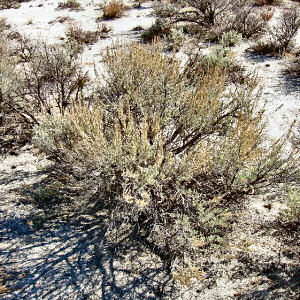
Sagebrush was everywhere in 1931, when the workers rode the transports from camp to the dam site.
With stems smooth and silvery with evergreen wedge-shaped leaves, the plant is part of the Artemis family named after the Greek virgin goddess of the hunt and wild nature. It is Nevada's state plant.
It can also grow the size of a grown man up to seven feet tall. It's stout at its trunk with silvery branches and dense clusters of tiny yellow or cream-colored flowers that bloom in late summer. It's seeds are tiny and black and each plant may produce up to one million seeds.
The sagebrush supports many wildlife species, such as pronghorn, mule deer, grouse and many small mammals. Sage grouse use large clearings in the sagebrush habitat to conduct spring mating dances. Early morning, one can see in these areas, known as leks, males inflating yellow air sacs upon their chest, puffing up their feathers and spreading their tail feathers before strutting around the lek in the attempt to bond with one or more females. The sagebrush then can be said to act as audience.
The leaves contain aromatic oils with a turpentine fragrance, and after a rainstorm, they perfume the air with a sweet, pungent aroma. For those that come upon sagebrush in the desert, it is delightful. There is so much of it everywhere, it can be said to give the feeling of prosperity. Especially to the men that came upon its abundance, after being so long out of work, and on the streets, standing in line for bread.
When it was actualized, when the men felt they had suddenly "hit it rich" by getting a job at the dam, three square meals a day and a bed to sleep in, suddenly men, like sagebrush, were everywhere.
Yet prosperity is not worth much unless it is useful beyond the day to day requirements for living. And it is known that sagebrush is not only an abundance of color amid the parched desert, it can be used for fuel or as Native Americans once did, used in building. The leaves and the seeds can be eaten. And the leaves, which contain camphor, can be used medicinally for coughs, colds, headaches, stomach aches, fevers and to relieve pain during child birth! Poultices of wet leaves can be applied to bruises to reduce swelling.
Beyond that, Navajo weavers would boil the leaves and flowers to create a yellow-gold color, used to dye wool. The Ute's used the shredded bark for candle wicks.
The men working on the dam made the dam prosperous, and each man had a use far and above his function as a worker. His thoughts created a tempo for the time. His communication with others offered insight to aid in understanding and perspective. In other words, what we see before us is outright amazing, no matter if it's the sight of something along the road. But it's the thing itself that harbors the real amazement. We must get closer still to what interests us. Study it in action.
Subscribe to:
Posts (Atom)

 Posts

