Building the Dam Story

At the end, if there is success, one wonders how. Through this wonder one discovers the story. This blog is dedicated to that discovery.

Showing posts with label greatness of spirit. Show all posts

Sunday, July 4, 2010

Architecture


The architecture for the Hoover Dam incorporates an art deco theme, utilizing an artistic vision, a structure that comments on a period in time.

During the 1930s the investment in art was made for appearance sake, to demonstrate that no matter how "poor" a people were, art was not only alive but thriving. The building of the dam was a good place to demonstrate this, with its art deco appearance, as well as the interior of the dam, where the tours were planned to take place. The floors are marble using Italian design and Native American symbols to represent a culture that depended on outside traditions to complete it.

On a day every year that people come together to celebrate the American holiday of Independence, it is a good time to remember the interdependence of life, demonstrated graphically at Hoover Dam, through the people that helped build it to the art that represents a time in culture that continues because of its art.

What we recognize as beauty is not ever one man's sole vision though it may be credited as so. That one man is duly interdependent on so many other things---which the architecture of the Hoover Dam and its interior spaces mark the visions of many. A dam which serves many. An icon of American beauty.

Saturday, June 12, 2010

Why Society

We are interdependent as all nature is, and the work at the dam replicates this truth a thousand times over. For the men that blasted and mucked the diversion tunnels could not do one without the other. The concrete poured could not have ever been done by one man alone. We need society to build, to do a job, which is not saying anything about the ethics of the job.

Why society is seen at fault for so many blunders may be that when like-minded people come together stuff happens. Stuff that nobody accounts for, stuff that no one really needs but then must deal with. Which explains the need by some to escape society, to be rid of it, to be done all the way from its core.

Men who came to the dam for work did so because there weren't a lot of job opportunities available at the time. They also came because of the shear opportunity to build something of such dimension. Those that came for the second reason often left before the job was done, upon seeing that this society of workers, as interdependent as they were, also were being snowballed into a project that treated men as machines. Or men as a labor force that could be controlled.

Society or societies are indicators to be used to identify patterns, cause and effect, the institutionalization of ideas. Do we buy into them? Do we avoid them all together? What seems to count for more is that we recognize our interdependence upon nature and in fact, to really "be alone" is a romantic notion, a fantasy, a fallacy.

Wednesday, May 26, 2010

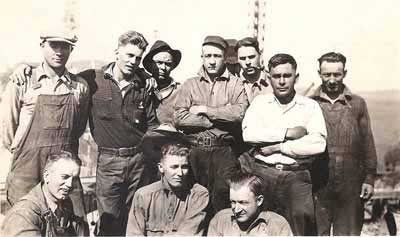
Faces of a time


In this picture is grandfather, just one of many who helped build the Hoover Dam. He is the one that hides his fatigue, that has known easier times. There is however a greatness of spirit in his eyes. He has overcome his fear, the fear of not being able to take care of his family, and in this fear he has joined his spirit with so many others.

How do people overcome their fears but with the help of their friends? In work in war in waging a life of strife, there is a presence of patience among men and women. There is solitude in the most remarkable places and times. Amidst the building of the dam, these men may have been alone with their thoughts but had one another to see these thoughts through, to level, to balance, to befriend.

Tuesday, May 25, 2010

Seeing the Dam-Age

Marshal McLuhan, who coined the phrase "The media is the message", has an anecdote in Gutenberg Galaxy which demonstrates that what one sees in another person, in a situation, in history, is a learned response.

The anecdote centers on a team of French health officials showing a group of African villagers, that had never seen a film before, a public health movie.

After the film was over the team asked the villagers what they had seen. The officials expected to hear something about the health dangers of water after it's been standing too long, which was their own, albeit, perspective and purpose.
And after a period of silence one of the villagers spoke up. "They have chickens there, too," he said.

The health officials were obviously set back by this answer. But what did they expect? The villagers had not learned to see film in the same way. They had not learned what to see. And equally so, the health officials had missed the chickens altogether.

As the Hoover dam was being built, it was very likely that the workers forgot or maybe never even considered why it was being built. In other words, they did not see the "why" of the dam so much as having learned to see the "how" of it. They worked to build what would serve themselves through employment. For most it was all they needed to see.

Perhaps if those same workers had learned to see the whole of what they were creating, for instance, to see the permanent damage the dam would do to the river's ecosystem, it may have changed the course of history.

However for many, what they saw within themselves was desperation, confusion, and disappointment. They'd been taught to see a dream and come close to living it. But then it vanished right before their very eyes. Faced with an economic depression that only a few saw coming, building the dam was viewed as hope itself, as relief from such devastation.

And were there teachers or gurus or spirit guides or what have you on even a single corner? There were just more people like themselves. A generation that would have to learn to see not just their own dreams but also into each other's future.

Today some may view the dam as a sign of our failing times, that it's ruined a great river by capitalizing on the river's wealth.

Yet one can also see the dam for its wealth in and of itself--as a feat such as Stonehenge, without need for anything other than awe.

Nevertheless, it's a icon for discovering "they had chickens, too."

We see what we learn to see. We learn to see the whole.

Monday, May 3, 2010

Learning the ropes


There were young men on the job who delighted in an opportunity to perform feats of extreme danger. They could hang all day by ropes against the canyon walls, as if performing a highwire act.

Yet there were also men such as the elderly gentleman who had to close his store for lack of customers, due to a downturn in a once thriving economy, leaving only a sign on the door that said: Stay well.

As the lone pharmacist in his small town, now without a drugstore, he knew people would have to travel thirty miles away for their medicines, or more likely, go without. It was difficult to leave them. Yet this day in May, 1931, under the hot sun of a brilliant Oklahoma sky, this man started out all over again, heading west. Heard there was work on a dam being built in the middle of the desert. Hitched a ride and said good bye to his past--determined himself to stay well.

There were many men like this that came to the Hoover Dam to work during this hot, dry month of May. Yet having to learn the ropes by working a job they'd never done before didn't give them reason to complain. A job was a job and they knew it had to be done the best they could do it. Otherwise there was somebody else waiting in line for the chance.

With more hope and guts than even they expected to have, these older men didn't arrive asking to be cared for, or asking who was going to help them. They had to set their pride down and be set apart by their willingness to learn and to keep well, despite the harshest conditions.

Thus their hard work without complaint truly involved a greatness of spirit. A formula ensuring care for the deepest of needs.