


To get a job, any job that paid you enough to eat and have a roof over your head, this was "all" a man was looking for during the 1930s Depression. His needs seemed desperate to obtain, his wants seemingly without virtue. The Depression at that time had tilted life out of balance and it caused fear in men they'd never expected nor experienced. To be refused meant the same thing for many people. Thus when one was refused a job or opportunity there was a rally among others in the same situation.
Part II of Joseph Campbell's Hero's Journey (see June 14 Blog to connect to part I) is the Refusal of the Call. In the story Hard Luck the emotions of everyone are riding on an exterior refusal, in other words the refusal for citizens of the U.S. to get what they need was predominant. When fourteen year old Jake Adams knows things are changing because of his response to other people he's around, he refuses the call to allow these changes to take place. Eddie McIntyre is quick to keep Jake in his place, limiting his esteem, and Jake allows this. Cora White is a girl Jake is interested in, but does she know it? And the boss, (and there are many) challenges Jake at every turn and Jake questions his ability rather than rises up to it.
All along, the sentiment of the time is also heaving downward onto Jake. He will need help now to let the changes that need to happen occur. But who will Jake turn to? Part III Supernatural Aid...
Showing posts with label self-discovery. Show all posts
Showing posts with label self-discovery. Show all posts
Tuesday, June 15, 2010

Monday, June 14, 2010
Hero's Journey part 1

According to Joseph Campbell, the Hero's Journey is an archetypal pattern forming the under-structure of every story ever told. It is a pattern that illuminates the stages everyone must go through in order to grow. It's a journey of personal evolution that every human being can identify with. And it all begins with The Call to Adventure.
The Call to Adventure is the point at which the person is first given an idea or notice that everything is going to change, whether he or she knows it or not.
In the historical fiction novel Hard Luck, newly orphaned 14 year old Jake Adams arrives at the site where the Hoover Dam will soon be built. Camping in Ragtown, near the Colorado River, with thousands of others like him waiting to get a job at the dam, he is confronted with three things informing him that change is in the forecast. For one, he meets his antagonist Eddie McIntyre, a bit older and a lot more independent, Eddie sees Jake's hidden side the way a gardener knows what's planted underground. Secondly, there's Cora White, a pretty girl that is ill when Jake meets her and he's able to help her get well using his family medicine. Thirdly, there's the big boss that arrives in Ragtown with an entourage to investigate the passage upriver to the dam. Jake is impressed with the way he stays cool despite men literally begging him for a job.
For this story it is other people in Jake's life that furnish the impetus for change. As Jake confronts the mystery that these three individuals hold for him in his life, he can't get closer to them without sensing the change that is about to occur in his life.
Part II will consider what Campbell refers to as The Refusal of the Call.
Monday, June 7, 2010
Stones of meaning
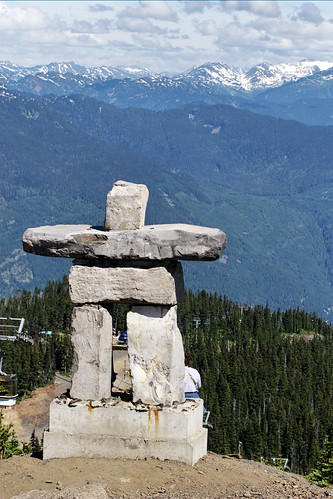
The Canadian Inuit use the symbol of an Inuksuk, which means "something which acts for or performs the function of a person." The word Inunnguaq is also used for this particular type of rock formation (that look more like a person rather than a conical heap of stones, and interestingly is shown on the cover of the Rush album Test for Echo).
I was given a small inuksuk today by a friend who recently traveled to Canada and brought back this "guardian spirit". Immediately I experienced a deep sense of gratitude and honor with this gift in my hand. It reminded me that all over the earth humans connect themselves with symbols unique as a design of stones, and with amazing feats such as massive concrete dams.
The surprise in all this is when we "use" a symbol of any kind to develop within ourselves greater understanding and appreciation of our culture, there's the chance we can see a bit farther into the future of our civilization. As Edward Abbbey suggests in his brilliant book, Desert Solitude,"Civilization is the wild river; culture, 592,000 tons of cement."
Wednesday, May 5, 2010
Women of Boulder City

The Boulder Dam Hotel was a needed addition to the town of Boulder City as the dam (Boulder/Hoover) was being built. It served the many who came to the dam as tourists, but also provided employment for residents of the town. Naturally, since many of the men worked at the dam, the jobs were filled by women.
Often, the jobs the women took became a bone of contention with the men. Some still believed a woman's place was in the home. Just as some men today believe women should carry the responsibility of a job. Regardless of the times, the forces of the status quo made people question necessity. And necessity is something that can always be questioned.
Nevertheless, Boulder City was known for it's friendliness, cleanliness, near-holiness among its residents and it made it easy for women to move about, establishing businesses, schools, parks and hospitals to again, having a menial job that gave them some economic freedom.
It's here at the Boulder Dam Hotel, comfortable, spacious and immaculate that became a place where some women for the first time in their lives could begin to take responsibility for their own life. Such menial tasks as housekeeping could mean economic freedom for a woman. She could further her education to become a doctor, teacher or architect. She could afford to pay her own way east and visit family. For often time, she had already up and left behind everything on behalf of her husband's last ditch effort for a job working on the dam.
The women of Boulder City, many torn from their past, would keep on choosing to add new life to their future. Like the Colorado River on a course altered by the dam, they were also destined in their direction all along.
Subscribe to:
Posts (Atom)

 Posts
Posts

