Building the Dam Story

At the end, if there is success, one wonders how. Through this wonder one discovers the story. This blog is dedicated to that discovery.

Monday, July 19, 2010

The Mighty Atom


Joseph Greenstein, the Mighty Atom, should have died as an infant, instead he lived and became one of the strongest men of his time. At 5' 5" and 140 lbs. he could pull a car by attaching his own hair. He developed secrets to his strength, based on near death experiences, which made him aware of the energy each person possesses.

A strongman to the nth degree, a man of this stature was needed in his day to encourage people in their striving and misfortunes, to be an example to others to develop good habits that help a person and not hinder them from helping themselves and ultimately others. When World War II broke out it was the Might Atom that went through the state of New York recruiting for the police force, offering men an opportunity to learn martial arts, to become stronger than they believed they could be.

A precursor to future superheroes, Mr. Greenstein, the Mighty Atom, was the authentic article.

Thursday, July 15, 2010

Black Canyon


This picture was taken before the turn of the 20th century. It reveals the darkness of this canyon, rock that reaches to the sky, the river subdued.

It is Black Canyon not Boulder Canyon where the final dam project was set. It is the highest section of the El Dorado mountains, yet a narrow passageway for the river itself. It is unique for it's precambrian mineral composite. It was virtually unknown until the dam was to be built.

The men working on this dam were told the Colorado River was wild. They believing it to be a river needing to be tamed. Yet when the workers stood on the shores here in Black Canyon did they feel the wildness of this river? Were they immersed in the relationship of rock against water, water against rock? Did those 5,000 workers question what they were doing? Were they really only here for a wage of four dollars a day? Did anybody stop to wonder, here in Black Canyon, not only the magnitude of the place but the smallness of their very being?

Guy Lombardo, Kate Smith, "RIVER STAY 'WAY FROM MY DOOR" (1931)


Bandleader and musician, Guy Lombardo and singer, Kate Smith were very popular in the early 30s. The song, 'River Stay 'Way from Me' is timely.

At the dam site, radio broadcasts weren't heard much until the men moved into the dormitories in Boulder City in '32. However, this might have been just the tune to play at the first dance celebrating the start of the dam in July of 1931.

...What is music to a culture but an expression of its hope and an acceptance of what can change in the blink of an eye as well as over time...

Guy Lombardo, Kate Smith "TOO LATE" (1931)


Picture yourself, after months of mucking on the roadbed, the groundbreaking for the dam begins. For this honor you've been invited to the American Legion for a dance. Here, women and girls from Las Vegas and the soon to be built town of Boulder City arrive, as well as those from Ragtown that may have temporary residence but nonetheless share in the excitement.

Men smoke cigars outside the hall, women sip fruit punch, cool and delicious. It's late spring, 1931, and the music of Guy Lombardo, with the lilting voice of Kate Smith play on the gramophone, as if made for this night. Yes there are some things that are "Too Late" but there's an amazing amount of work ahead that nobody knows just how dramatic it will be. And above it all, regained hope fills the air.

Time is money 1931 Buick


Frank Crowe, the chief engineer of the dam, drove only a Buick, a big, bold, beautiful, Buick. When you saw Crowe's Buick parked in front of Anderson's mess hall, it meant that you would be in for a speech about increasing the speed in which you worked.

Thus, even hood ornaments tell a story about the people that drove these cars. Time is money, and money is beauty.

Wednesday, July 14, 2010

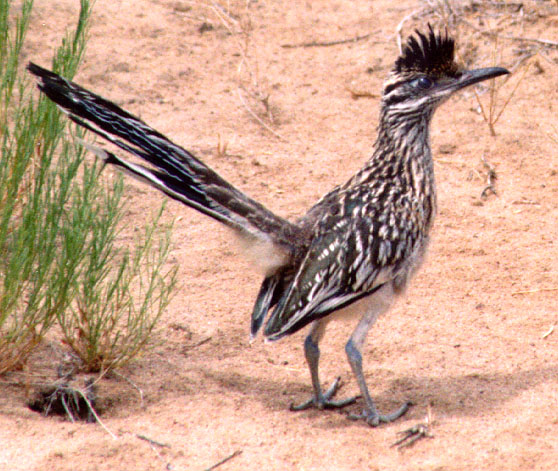
desert roadrunner


To avoid flying, the desert roadrunner runs! Up to 17 miles an hour! Oh, sure if it is scared, or going downhill, it can fly. Yet it prefers to travel by foot. It keeps cool as many other creatures of the desert do, by limiting travel during the heat of the day. And it gets hungry--mostly for snakes,(capturing rattlesnakes by wrapping its cape-like wings around it) lizards and insects. And it shares, the male offering tidbits of a tasty find with a female friend.

Yes, the roadrunner, at rest beside a creosote bush, with a call similar to a dove, is a reminder that creatures in the hostile desert environment populate the landscape by virtue of keeping the "road to itself."

Sure it is prey to hawks raccoons and cats, but the roadrunner avoids the thing it should do, fly, and avoids its predators by running. In other words, what is expected isn't always the answer. The unexpected, such as running instead of flying, is a preference and one that works for the roadrunner. Consequently it stands out as its main feature.

There were men who left the job on the dam to do something else, hitching a ride on a train car heading west, north, east or south, perhaps for a better job, or maybe even just to be near family or to try something else.

However, the men were expected to stay, since the pay was regular and the food was decent and it was a matter of principle to get the job done along with the others. Yet it wasn't enough to get some men to "fly" like the others. Thus names were given, such as drifter and grifter, describing their unexpected behavior. When really, for the individual, name or no name, it was just as adaptive to run as it was to fly with the others.

Monday, July 12, 2010

1. Art and poetry 1930s


THE VENTILATOR, Arthur Osver, American (b. 1912), oil on Masonite

In the 1930s, American art took a unique point of view independent of European themes but rather the social concerns and aspects of traditional American life.


As a poet, William Carlos Williams escaped the disadvantages and hardships many of his peers succumbed to. He was a medical doctor by profession, and also a man with poetry to heal a people of his time and a beacon for those who look to his words still.

A Sort of a Song

Let the snake wait under
his weed
and the writing
be of words, slow and quick, sharp
to strike, quiet to wait,
sleepless.
-- through metaphor to reconcile
the people and the stones.
Compose. (No ideas
but in things) Invent!
Saxifrage is my flower that splits
the rocks.

William Carlos Williams